Here is the short version, for the nights you're too tired to read to the end.
You close the day the way a good shop closes: on purpose, at a chosen hour, with a small ritual that turns the sign to shut. Not with a drink. With a border.
Most of us were taught the opposite — that the day ends when you finally stop, drop onto the sofa, and pour something to take the edge off. But the edge doesn't come off. It goes quiet for two hours, then comes back around 3am to collect.
The nightcap was always a trick
A drink feels like it works, and that is exactly the trap.
Alcohol is a sedative, so for the first half of the night it does its job — you go under fast. Then your body starts clearing it, and the night turns on you. A 2024 review pooling 27 studies found that alcohol delays and shortens REM sleep — the deep-dreaming, memory-filing kind your brain does its housekeeping in — and the disruption begins from as little as two standard drinks, worsening with every glass after [1].
The bill falls due in the small hours. Clear five drinks by around 3am and arousal climbs from that point on: lighter sleep, more waking, the ceiling-staring stretch you won't quite remember but will feel all of the next day [2].
The nightcap didn't close the day. It borrowed two hours and charged interest on the morning.
Your body already knows how to power down
Here is the part worth knowing: you were built for this.
Cortisol — the stress hormone that keeps you alert and tells the body to hold on to everything — runs on a daily clock. It peaks near waking and falls all through the day to its lowest point at night, right as you're meant to sleep [3]. The evening dip is the whole mechanism. It is your body, quietly dimming its own lights.
So the machinery is fine. The trouble is upstairs.
The problem isn't the hour. It's the mind still running.
You can be bone-tired and still wired, because tired and calm are two different switches.
Sleep scientists call the culprit pre-sleep arousal, and it comes in two forms: the cognitive kind — racing thoughts, the replay, tomorrow's list — and the somatic kind, a body that won't slow down, heart still going [4]. Leave both switched on long enough and it hardens into what they call chronic hyperarousal: a nervous system that has forgotten how to stand down [4].
And the mind is what keeps the body lit. Dwell on a hard day and that natural evening cortisol dip can simply fail to arrive — rumination has been shown to hold the level up, so the hormone that should be ebbing away keeps you switched on instead [5].
I know the feeling from the inside. Five years on Wall Street taught me how to switch on, and never taught me the other half. The trading day would end and my nervous system wouldn't — body in bed at last, mind still standing at the desk, running the same numbers in the dark. I called that being driven. It was just a switch I didn't know how to find.
I wake at 5:00 and I'm at the gym by 5:15, every day; my friends call it the 5:15 Club. For years I thought that discipline was the whole answer. It isn't. You can't out-train a switched-on nervous system. Rest is the other half of the work — and the evening is where you practise it.
Draw the border on purpose
You don't argue a racing mind into silence. You give it a ritual instead, a sequence it can learn.
The advice from the Sleep Foundation is almost boringly practical: in the 30 to 60 minutes before bed, do the same few calm things in the same order, every night [6]. The repetition is the active part. Done often enough, it teaches your brain to read the routine as the off-ramp.
Two moves do most of the work. Dim the lights — bright light and screens suppress melatonin and tell your body it is still daytime [6]. And put the phone face-down, because the feed is a machine built to manufacture the exact racing mind you're trying to end.
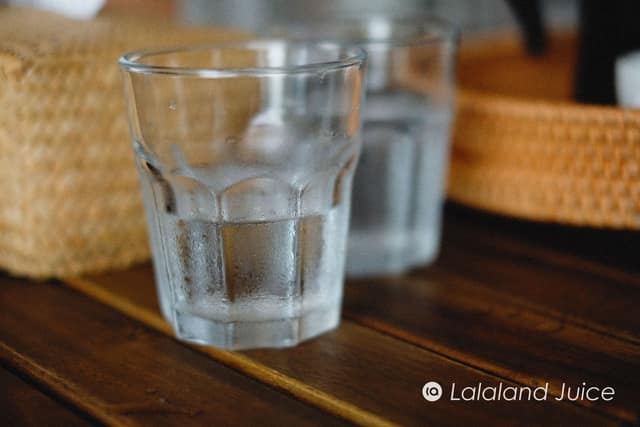
Then give your hands and your senses something slow. A warm shower. A real page, turned by hand. The aircon down low, the flat gone quiet. A cold drink you actually taste, poured into a proper glass.
The pour that closes the shop
For years I had no border at all — the day simply ran until I dropped. Now I make one on purpose.
I pour something cold into a proper glass, lately a Pink Haze: blush-pink grapefruit, bittersweet and grown-up, the kind of drink that feels like an occasion without asking to be one. I sip it slowly while the lights come down. That is the whole ceremony. The pour is the sign turning to shut.
The stopping does the work. The bottle only marks the hour it begins — a border small enough to hold in one hand.
What a closed day gives back
This matters more here than almost anywhere. Singaporeans are among the most sleep-deprived people on earth: just 44 per cent of us get seven hours or more a night [7]. Two in five wake up tired every single day — more than three times the global average — and the reason we name most often is stress [8].
That is the quiet tragedy of the switched-on life. We are exhausted by the very thing that won't let us rest.
A closed day is the way out, and it is a skill, not a stroke of luck. The grown-up move was never the drink that knocks you flat. It is the border that lets you come down on your own.
The sign says shut
Tonight, try it once. Turn the lights down before you're tired, not after. Pour the cold thing. Let the day end at an hour you chose, instead of the hour you finally collapsed into.
The city will still be there in the morning. For now, the sign says shut — and that, quietly, is the most disciplined thing you will do all day.
Jay Qin is a long-term guest columnist for The Slow Sunday Journal, and the founder of the 5:15 Club.